|
|
|---|


|
|
|---|


Friday, October 10, 2008
Rob Thomas Song Inspired by Dog
For those of you who are fans of Matchbox Twenty and their lead singer Rob Thomas, you probably already know that Rob Thomas is an animal lover. In fact, the song he wrote for the Disney Movie "Meet The Robinsons" which was released in 2007, was inspired by his dog.
As Rob Thomas tells the story, he was having a bad day, and gets back to his room, and his Terrier Mutt is there to greet him. The dog is just looking at him, not really caring that Thomas had a bad day. Seeing his dog made him realize that it doesn't matter how the day went, his pet doesn't care. And of course, the dog also cheered up Thomas.
Here is a youtube link to the video of the song.

Thursday, October 9, 2008
Alapaha Blue Blood Bulldog pictures
The Alapaha Blue Blood Bulldog (ABBB) or Otto is an American rare dog breed, developed in the Alapaha River region of Southern Georgia. [wikipedia]
 Alapaha Blue Blood Bulldog picture
 Alapaha Blue Blood Bulldog photo
 Alapaha Blue Blood Bulldog wallpaper
His name is Jo-Lin's Mad Ball, call name Igor, owner is Linda Fadigan, Jo-Lin Kennel
 Alapaha Blue Blood Bulldog picture
Displaying an unexaggerated and natural bulldog type, the Alapaha is nevertheless a sturdy, well-developed, and muscular breed. Descriptions of its size vary greatly, calling for males anywhere from 65 to 90 pounds (30 to 45 kg) standing 19 to 26 inches (48 to 66 cm) at the withers, females smaller at 60 to 70 pounds (25 to 30 kg). Ears and tail are natural, with no cropping or docking. Colors of the Alapaha are varied, typically white or different shades of black, grey, red,white, fawn, brindle, brown, buckskin, or mahogany, always with white markings; some dogs are piebald spotted.
 Alapaha Blue Blood Bulldog photo
The Alapaha Blue Blood Bulldog is described as trainable, dutiful, and responsible, with impressive capabilities as a guardian of family and property. It is very protective, but can be loving in the home.
 Alapaha Blue Blood Bulldog wallpaper
His name is Jo-Lin's Mad Ball, call name Igor, owner is Linda Fadigan, Jo-Lin Kennel

Alano Español dog pictures
Alano Español or Spanish Bulldog is a Spanish breed of dog that derives its name from the Molosser Alaunt. The breed received recognition from the Spanish Ministry of Agriculture and the RSCE in 2004. [wikipedia]
 Alano Español dog picture
 Alano Español dog photo
 Alano Español dog wallpaper
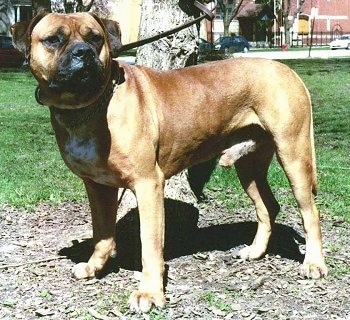 Alano Español dog picture
The Alano Español is a powerful dog, suitable for running, herding cattle and holding large animals. This dog has a well proportioned body structure and a deep chest, strong shoulders and withers. The back legs are slightly shorter than the front legs, which are straight when viewed from the front or the side. The muscles in the hindquarters are well developed and the hind legs show very well defined angulation.
Alano Español dog photoThe Spanish Alano today is a legacy od the Alan tribe which entered the Iberian Peninsula with the Vandal hordes during the early part of the 5th Century. The Alani were one of the Sarmatian peoples which inhabited the plains along the River Don to the northeast of the Sea of Azov in modern-day Russia. Formidable horsemen and skilled bowmen, these warring nomads were also famous for their dogs.
 Alano Español dog wallpaper
Rare breed dog
Rare breed (dog) is any breed of dog that is few in number. Since dogs have greater genetic variability than other domesticated animals[1] the number of possible breeds is vast. New breeds are constantly being created, with only a few "rare" puppies available at first, and even long-established breeds may have small populations. [wikipedia]
 Rare breed dog
 Rare breed dog photo
 Dog of Rare breed
 Rare breed dog
 Rare breed dog photo
 Dog of Rare breed
Picture of Molosser dog
Molosser is a type of large, solidly-built dogs comprising several breeds, probably all descended from the same root stock. The name derives from Molossia, a subregion of ancient Epirus, in North-West Ancient Greece. [wikipedia]
 Picture of Molosser dog
 Molosser dog photo
 Molosser dog image
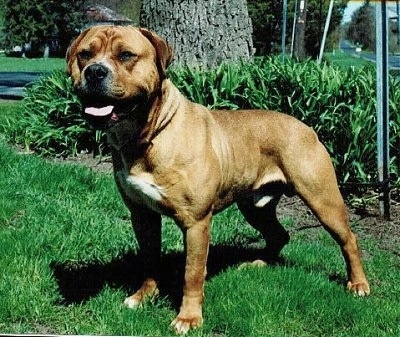 Picture of Molosser dog
Molossers are sometimes called "mastiffs". The proper noun "Mastiff", however, is used to refer to the English Mastiff, a breed that originated in England over two thousand years ago. Other terms include "Mastín" (Spanish), "Dogge" (Germanic), and "dogue" or "dogo" (Romance languages).
 Molosser dog photo
The first known record of a molosser-type dog was in 1121 BC, when a Tibetan mastiff trained for hunting was given to a Chinese emperor. The mastiffs would later be imported to Mongolia, Mesopotamia and Central Asia where they would mix with local dogs, resulting in a loss of long hair and colour uniformity.
 Molosser dog image
Alangu Mastiff dog top pictures
The Alangu Mastiff is a rare dog breed from Southern India, from the Thanjavur and Tiruchi districts. They are used as fighting dogs in Pakistan and are excellent guard dogs. [wikipedia]
 Alangu Mastiff dog top picture
 Alangu Mastiff dog photo
 Alangu Mastiff cute dog
 Alangu Mastiff dog top picture
This is a tall breed with a noble carriage and short coat. The dogs may be red, fawn or brindle, markings vary. The muzzle is black and the skin around their neck and mouth is loose. The brisket is deep, and the limbs are well muscled. The back is long with the tail tapering to a fine point. The ears are set high on the skull and pricked. It has a long and graceful stride. Their height varies between 73,6 to 76,2 cm. (29-30 inches).
 Alangu Mastiff dog photo
The Persian Army used Indian mastiffs, but just for guarding and were introduced into Greece by Xerxes the First when he marched towards this country in 486-465 B.C.
 Alangu Mastiff cute dog
Wednesday, October 8, 2008
Aniversário 2 anos + Nova espécie de Hemigrammus
 Mais uma ano se passou, e o NATURE PLANET entra em seu 2º aniversário.
Tentando seguir seu propósito, de apresentar assuntos a nível cienífico, além de questões que envolvam o meio ambiente e aquarismo, de uma forma prática e dinâmica aos leitores, o NATURE PLANET vem conquistando seu lugar, contando com um público de mais de 19.000 leitores, envolvendo até o momento 94 países.
Agradeço a todos os amigos da blogosfera que fiz até o momento e a todos os leitores pelos comentários e sugestões!!
Hoje o NATURE PLANET é o que é graças a todos vocês leitores, por isso sou muito grato a todos!!!


 Papers: Aquapress
Para festejar esse segundo ano, apresentamos a descrição de uma nova espécie do gênero Hemigrammus (Gill, 1958).
Uma nova espécie de Hemigrammus do alto rio Tapajós.
Uma nova espécie do gênero Hemigrammus é descrita do rio Juruena, bacia do rio Tapajós no estado do Mato Grosso. Descrita pelos ictiólogos Heraldo Britski e Flávio Lima, esta foi nomeada de Hemigrammus silimoni, sendo endêmica da bacia do alto Tapajós.
A nova espécie é distinta de seus congêneres por apresentar uma mancha elipsóide similar a um ocelo no lobo superior da nadadeira caudal, uma característica autapomórfica que a distingue de todas as demais espécies do gênero e mesmo de outras espécies de Characidae.
Hemigrammus silimoni apresenta cinco dentes na fileira interna do prémaxilar, uma linha lateral incompleta e a nadadeira caudal com escamas em sua base, uma combinação diagnostica de Hemigrammus (Eigenmann, 1918; Géry, 1977).
A nova espécie é distinta de seus congêneres por apresentar uma mancha elipsóide similar a um ocelo no lobo superior da nadadeira caudal, uma característica autapomórfica que a distingue de todas as demais espécies do gênero e mesmo de outras espécies de Characidae.
Hemigrammus silimoni apresenta cinco dentes na fileira interna do prémaxilar, uma linha lateral incompleta e a nadadeira caudal com escamas em sua base, uma combinação diagnostica de Hemigrammus (Eigenmann, 1918; Géry, 1977).

Géry (1977), subdividiu a espécie Hemigrammus em cinco grupos. Dentro desta estrutura, Hemigrammus silimoni entraria no grupo "a" das ''espécie sem marcas negras no pedúnculo umeral" (sem manchas no pedúnculo, faltando o pedúnculo umeral e/ou na nadadeira dorsal). Considerando aqueles grupos, o gênero Hemigrammus, com certeza não representa entidades monofiléticas. A nadadeira caudal assimétrica e colorida, com pigmentação negra é restringido ao lóbulo da nadadeira dorsal ou ventral, característica relativamente rara dentro de Characidae. A pigmentação negra é restringida em alguns casos ao lóbulo ventral da nadadeira caudal (Hemigrammus hyanuary, Thayeria spp.) ou mais frequentemente ao lóbulo dorsal (Brycon melanopterus, Triportheus pictus, a maioria de espécie de Bryconops, Astyanax metae, e as espécies do complexo Moenkhausia lepidura).

Na localidade tipo da espécie, o rio Juruena possui aproximadamente 2 metros de profundidade, com águas rápidas e cristalinas, possuindo fundo composto por rochas e areia. A vegetação de borda era composta principalmente por gramíneas, intercaladas por mata de galeria.
Nos espécimes coletados foram encontrados em seus intestinos matéria de origem vegetal e principalmente algas.
Silimoni se refere a Keve Z. Silimon, em reconhecimento aos seus esforços longos e contínuos em documentar a ictiofauna do Mato Grosso.
Para mais informação: Britski, HA;Lima, FCT. A new species of Hemigrammus from the upper Rio Tapajós basin in Brazil (Teleostei: Characiformes: Characidae). Copeia, 2008, pp. 565–569, 2008.
Adaptado e traduzido por Ricardo Britzke
© Copyright 2008 ©
Subscribe to:
Posts (Atom)
|
|
|---|


